
In short: The Australian Government has confirmed the biggest overhaul of the NDIS since the scheme began. From mid-2026, a new planning framework, a standardised I-CAN v6 assessment, and tighter funding rules will start to change how your occupational therapy (OT) supports are assessed, funded and delivered. Here is what is changing, when, and how to protect the supports you rely on.
A turning point for the NDIS – and for occupational therapy
If you, your child or someone you care for receives NDIS-funded occupational therapy, 2026 is not a year to sit back and hope for the best. On 22 April 2026, Federal Health Minister Mark Butler stood at the National Press Club in Canberra and confirmed the next stage of NDIS reform – the most significant changes to the Scheme since it was created under the NDIS Act 2013.
These reforms follow the NDIS Amendment (Integrity and Safeguarding) Act 2026, which was passed by Parliament on 1 April 2026 and received Royal Assent on 8 April. Together, they signal a clear direction: the Government wants the NDIS to be more sustainable, more consistent, and more tightly focused on people with permanent and significant disability – and that has real implications for how OT supports are planned, funded and reviewed.
At Capability Support Services, we work with NDIS participants every day across the Gold Coast, Brisbane and Northern NSW. We know how unsettling these announcements can feel. The good news is there are no immediate cuts to your day-to-day OT supports – most changes will be rolled out gradually between 2026 and 2030. The better news is that, with the right preparation and the right OT in your corner, you can still get the supports you genuinely need.
Let us walk you through it.
Why is the NDIS changing?
The Government has been clear about its goals. The reforms are designed to:
- Slow the long-term growth of the NDIS so it remains financially sustainable.
- Shift everyday supports back into mainstream and community services, rather than being funded inside individual NDIS plans.
- Refocus the Scheme on participants with permanent and significant disability whose needs cannot reasonably be met outside the NDIS.
- Improve consistency in how plans are built, so two people with similar support needs receive similar funding regardless of who their planner is.
The headline numbers tell the story. Participant numbers are projected to fall from around 760,000 today to approximately 600,000 by the end of the decade, and average annual NDIS spending growth is expected to drop to roughly 2% per year through to 2030 before stabilising at 5% growth.
This does not mean OT and other allied health supports are disappearing. Occupational therapy remains explicitly listed as a funded NDIS support. What is changing is how your need for it is assessed, how it is documented in your plan, and how much detail you and your therapist need to provide to keep your supports flowing.
The 5 biggest NDIS changes affecting your occupational therapy in 2026
1. A brand-new planning framework rolls out from mid-2026
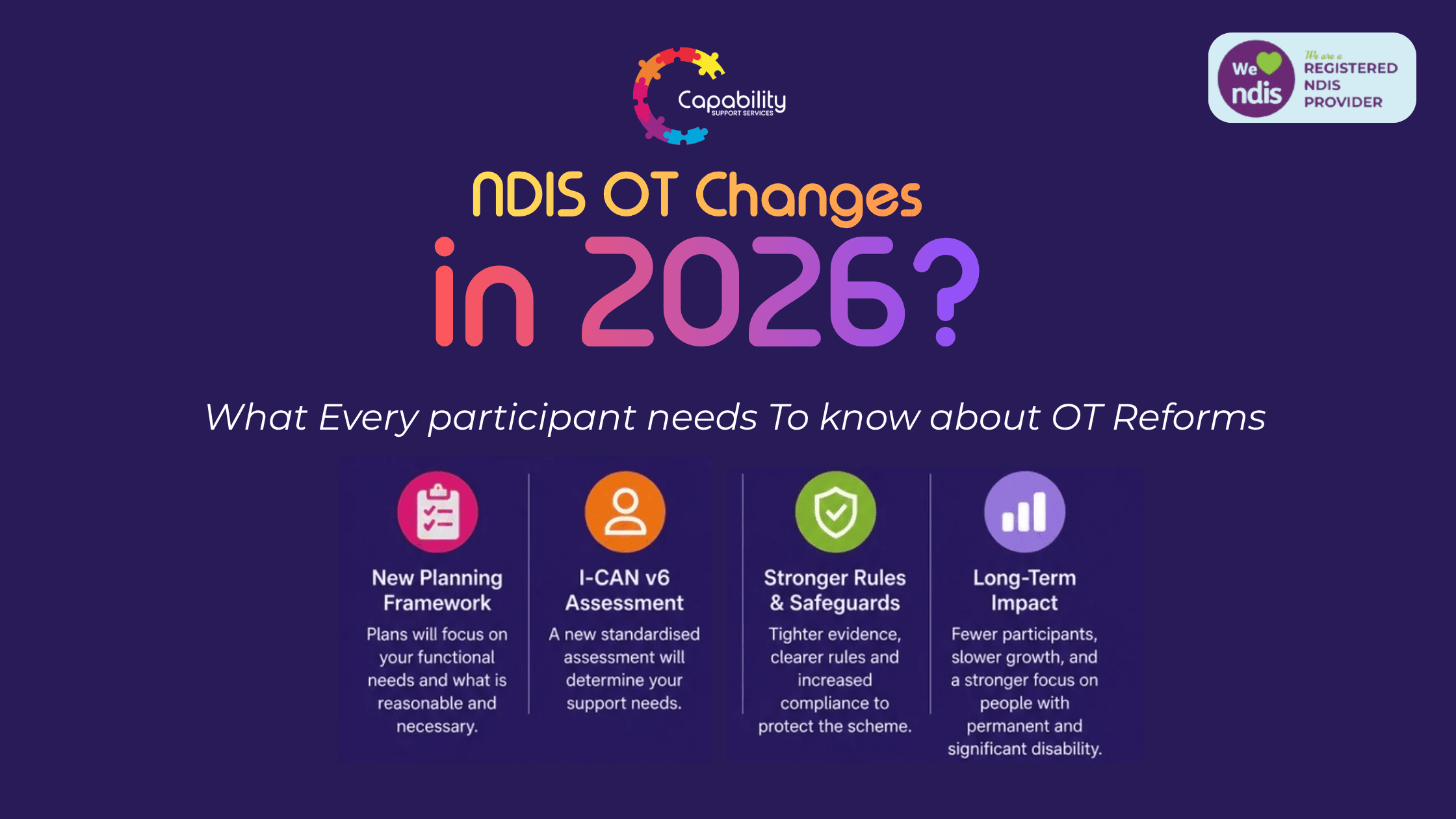
From around July 2026, the NDIA will begin replacing the current planning system with a New Framework Planning model. The first group to transition will be participants aged 16 and over, with a phased rollout continuing through to 2030.
Under the new framework:
- Plans will be built around a standardised support needs assessment rather than relying heavily on multiple, fragmented therapy reports.
- Funding will focus on what is reasonable and necessary for your functional, disability-related needs – not general living costs.
- The structure of planning conversations will be more consistent across the country, with less scope for case-by-case negotiation.
- Plans are expected to last longer, giving more stability between reviews.
For OT participants, the practical impact is that the language of “functional impact” matters more than ever. A diagnosis on its own is no longer enough – the documentation needs to clearly show how your disability affects daily life, and why occupational therapy is the right support to address it.
2. The I-CAN v6 assessment becomes the new standard
Perhaps the most significant practical change is the introduction of the I-CAN v6 assessment as the standardised tool for measuring NDIS support needs.
When your plan comes up for review under the new framework, your support needs will be assessed using I-CAN v6, conducted by an accredited allied health professional – including occupational therapists, psychologists, physiotherapists, speech pathologists or social workers. The assessment is funded by the NDIA, so it does not cost you anything directly.
What this means for OT participants:
- The assessment is a structured, point-in-time conversation about how you function across multiple life domains.
- Your treating OT can supplement the assessment with a detailed functional report – but the assessor’s I-CAN result will be the primary driver of your budget.
- People with fluctuating conditions, communication differences, or complex trauma histories may be more vulnerable to under-assessment if they are not well prepared.
This is one of the strongest arguments for working with an experienced OT before your assessment. A clear, evidence-based functional report from a clinician who knows you can make a meaningful difference to how your needs are understood.
3. OT pricing changes – and what they mean for your funding
Pricing for occupational therapy has been one of the most contentious issues of the reform. Here is where things stand:
- The standard OT rate remains at $193.99 per hour (weekday) under the current NDIS Pricing Arrangements and Price Limits – a rate that has now been frozen for seven years.
- From 1 July 2025, provider travel claims for therapy supports were reduced to no more than 50% of the applicable therapy hourly rate, capped on a pro-rata basis. This particularly affects mobile OT services delivered in-home or in the community.
- From the 2026–27 Annual Pricing Review, therapy price limits will be displayed in 10-minute increments, encouraging more flexible session lengths rather than defaulting to 1-hour blocks.
- National pricing now applies for some allied health professions (physiotherapy and psychology), removing state-based differences.
Occupational Therapy Australia has publicly raised concerns that the seven-year price freeze is putting clinical sustainability at risk, with around 8% of OTs already exiting the NDIS market in the past year. As your provider, we are committed to navigating these pressures while continuing to deliver high-quality, person-centred care – but it is important you understand the wider context.
4. A sharper focus on disability-related functional needs
Under the new framework, the NDIS is expected to apply a stronger, clearer test of “reasonable and necessary”. Supports that look like general living costs, parenting, or services that should be delivered through mainstream systems (such as health, education or aged care) may be reviewed at your next assessment.
For OT participants, this is mostly good news – occupational therapy directly addresses functional disability needs, which is exactly what the reformed NDIS is designed to fund. The risk is in how it is documented. Goals that are vague (“improve quality of life”) or generic (“learn life skills”) are weaker than goals that clearly link your OT support to a specific functional impact:
- “Improve safe transfer technique to reduce falls risk in the bathroom”
- “Build sensory regulation strategies to participate in primary school classroom activities”
- “Trial and prescribe assistive technology to enable independent meal preparation”
This is where a skilled OT becomes invaluable – not just delivering the therapy itself, but framing it in language that aligns with the new NDIS evidence requirements.
5. New rules for travel, cancellations and non-face-to-face work
Mobile OT services – assessments in your home, school visits, community-based therapy – remain a vital part of how we work. But the rules around them are tightening:
- Travel labour costs: capped at 50% of the therapy hourly rate.
- Travel time limits: 30 minutes each way in MMM 1–3 (metro), 60 minutes in MMM 4–5 (regional).
- Non-labour travel costs (tolls, vehicle wear) remain claimable separately.
- Short-notice cancellations: claimable when a participant gives less than 7 clear days’ notice.
For most participants, these rules are more about how invoicing works than about the care you receive. We will continue to come to you when that is clinically appropriate, and we will be transparent about any travel charges before sessions are booked.
The NDIS reform timeline at a glance
Here is when the major changes are scheduled to take effect:
| Date | Change |
| Mid-2026 (from July) | New Framework Planning begins (participants aged 16+ first) |
| July 2026 | Consultation begins on commissioning home and living supports |
| 1 October 2026 | Capacity-building daily activities and community participation budgets progressively adjusted |
| 2026–2027 | NDIS Quality and Safeguards Commission powers strengthened |
| July 2027 | Expansion of provider registration begins |
| 1 October 2027 | New plan management approach implemented (with 6-month transition) |
| 1 January 2028 | New rules on NDIS / mainstream boundaries apply to new participants |
| January 2028 | Thriving Kids program launches (children aged 0–8 with low-to-moderate developmental needs) |
| 1 July 2028 | Newly commissioned support coordination function begins |
| By end of 2030 | Full implementation of provider registration reforms |
Timelines may shift as legislation is refined, but this is the framework you can plan around right now.
What this means for you – by participant type
If you are an adult NDIS participant (16+)
You are in the first wave. When your next plan review happens after July 2026, expect to be invited to an I-CAN v6 assessment. Get your OT documentation up to date before that review.
If you are a parent or carer of a child with disability
Children under 18 are not in the initial 2026 rollout. Your child’s current OT supports continue under the existing rules. The separate Thriving Kids program, launching January 2028, will affect children aged 0–8 with low-to-moderate developmental needs – but children with significant or permanent disability remain eligible for the NDIS.
If you are a Support Coordinator or Plan Manager
Begin preparing participants now. Build evidence libraries, schedule reassessments where indicated, and connect participants with experienced allied health providers who understand how to write reports that align with the new framework’s evidence standards.
If you currently rely on home modifications, AT, or FCAs
Many of these supports require OT-led assessments completed in the home. With travel pricing reduced, scheduling these efficiently matters more than ever. Plan ahead, batch appointments where possible, and work with a provider who delivers across your region.
5 practical steps to take before your next plan review
- Update your Functional Capacity Assessment. A current FCA from your OT remains powerful evidence – even under the new framework. If yours is more than 12 months old, book a review.
- Document functional impact, not just diagnosis. Ask your OT to describe how your disability affects daily activities, not just what it is.
- Set goals that link directly to disability-related function. Specific, measurable, and tied to occupations that matter to you.
- Gather your evidence in one place. Therapy reports, AT trials, home modification reports, school reports, GP letters – all helpful at assessment time.
- Choose a provider with NDIS reform experience. Your OT’s understanding of the new framework will increasingly affect the quality of your evidence.
How Capability Support Services can help
We are a registered NDIS provider with experienced occupational therapists working across the Gold Coast, Brisbane and Northern NSW, plus expanding outreach into rural and remote communities. Our team supports children, adults and older Australians with:
- Functional Capacity Assessments aligned with the new NDIS framework
- Sensory Profile Assessments
- Assistive Technology prescription, trials and reports
- Home modification assessments
- Mobile and community-based OT in your home, school or workplace
- Telehealth OT so distance is never a barrier
- Combined OT and Speech Therapy for a holistic approach
- Aged Care / Home Care Package OT support for older Australians
We work alongside Support Coordinators, Plan Managers, families and other allied health professionals to make sure your evidence is strong, your goals are clear, and your supports continue without disruption – even as the NDIS evolves.
Concerned about your upcoming plan review? Speak with our team about a pre-review OT consultation. We will help you understand what the new framework means for your plan, gather the right evidence, and prepare for the I-CAN v6 assessment with confidence.
Call 1800 299 399 or email info@capabilityss.com.au
Immediate availability across the Gold Coast and Brisbane.
Frequently Asked Questions
Will I lose my NDIS occupational therapy under the 2026 changes?
No. Occupational therapy is explicitly listed as a funded NDIS support and remains a core capacity-building service for participants with disability-related functional needs. What is changing is how your need for OT is assessed and how it is documented in your plan. With well-prepared, evidence-based reports, OT support continues.
What is the I-CAN v6 assessment?
I-CAN v6 (Instrument for the Classification and Assessment of Support Needs, version 6) is the new standardised tool the NDIA is introducing to measure participant support needs from mid-2026. It is conducted by accredited allied health professionals – including occupational therapists, psychologists, physiotherapists, speech pathologists or social workers – and is funded by the NDIA at no cost to you.
When do the NDIS 2026 changes start?
The New Framework Planning model begins rolling out from mid-2026 (around July), starting with participants aged 16 and over. Other reforms – including changes to plan management, support coordination, and provider registration – are scheduled progressively between 2026 and 2030.
Are children’s NDIS supports changing in 2026?
Children under 18 are not in the initial 2026 rollout. Their current OT supports continue. From January 2028, a separate Thriving Kids program will support children aged 0–8 with low-to-moderate developmental needs, while children with significant or permanent disability remain eligible for the NDIS.
What is the current NDIS occupational therapy hourly rate in 2026?
The standard NDIS occupational therapy weekday rate is $193.99 per hour, set by the NDIS Pricing Arrangements and Price Limits. This rate has been frozen for seven consecutive years. Saturday and Sunday/public holiday rates are higher. Always check the latest official figures on the NDIS website for the most up-to-date pricing.
Should I get a Functional Capacity Assessment before my next plan review?
For most participants approaching a plan review under the new framework, yes – a current FCA is one of the strongest pieces of evidence you can bring to your assessment. Capability Support Services offers FCAs across the Gold Coast, Brisbane and Northern NSW with availability for new clients.
Where can I find official information about the NDIS reforms?
The most authoritative sources are the NDIS website and For personalised advice on what the changes mean for your plan, speak with your Support Coordinator or contact our team.
The bottom line
The 2026 NDIS reforms are real, they are coming, and they will change how occupational therapy supports are planned and funded. But they are not designed to strip supports from people with genuine disability-related needs – and OT remains a clearly funded part of the Scheme.
The participants who will navigate this transition most smoothly are the ones who get prepared early, work with an experienced OT, and build a clear evidence base that links their support needs to functional, disability-related impact.
That is exactly what we do at Capability Support Services. If you would like to talk through what the NDIS changes mean for your plan – or you simply want an OT in your corner who understands the new framework – we would love to hear from you.
Get in touch today on 1800 299 399 or email our team.
Disclaimer: This article is for general information only and reflects publicly available information about the NDIS reform process as at 28 April 2026. Implementation details may evolve as the NDIA finalises its rollout. For advice specific to your NDIS plan, please contact us or your NDIS Support Coordinator.